Dealer Digital Solutions: A Guide to Driving Growth
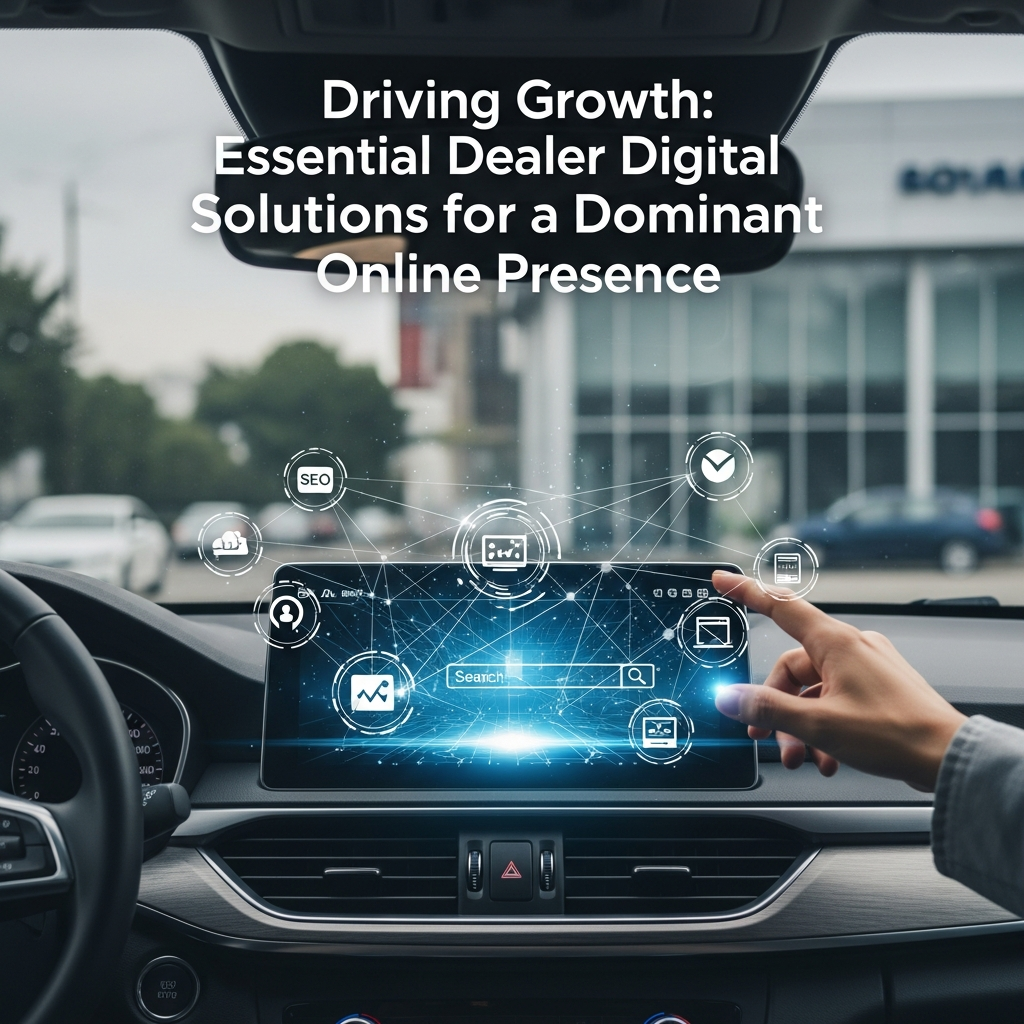
The modern car buyer’s journey no longer begins by walking onto a dealership lot; it starts with a tap, a click, and a search. In today’s hyper-competitive automotive market, your digital showroom is infinitely more important than your physical one. Foot traffic has been replaced by web traffic, and the dealerships that thrive are those that master the digital landscape. However, navigating this complex world of acronyms like SEO, SEM, and PPC can be daunting. Many dealers struggle to create a cohesive strategy, often throwing money at different channels without a clear understanding of how they work together to generate real, measurable results. This is where a robust suite of dealer digital solutions becomes not just an advantage, but a necessity for survival and growth. A strong online presence isn’t about simply having a website; it’s about being visible, engaging, and accessible at every single touchpoint of the customer’s decision-making process. This article will serve as your comprehensive guide, breaking down the essential pillars of a winning digital strategy. We will delve deep into optimizing your website, mastering search engines through both organic and paid methods, building a vibrant community on social media, and maximizing your inventory’s reach through smart syndication. By understanding and implementing these solutions, you can transform your online presence from a simple placeholder into a powerful, lead-generating engine that drives sales 24/7.
The Digital Handshake: Why Your Dealership Website is Your Most Important Asset
Before you can even think about driving traffic, you must first ensure you have a destination worth visiting. Your dealership website is the central hub of your entire digital strategy. It’s your 24/7 digital showroom, your primary lead capture tool, and the ultimate source of truth for your inventory and brand. A poorly designed, slow, or confusing website will sabotage even the most brilliant marketing campaign. To build a strong foundation, focus on several key elements that create a seamless and effective user experience.
First and foremost is a mobile-first design. The vast majority of initial car research happens on a smartphone. If your site is difficult to navigate on a small screen, potential customers will simply leave and go to your competitor. This means large, easy-to-tap buttons, simple menus, and lightning-fast load times. The heart of your site is the Vehicle Detail Page (VDP). This is where the virtual sale happens. Each VDP should be a rich, compelling experience with:
- High-Quality Imagery and Video: A minimum of 20-30 high-resolution photos showing every angle of the vehicle, inside and out. A short walk-around video can increase engagement exponentially.
- Detailed and Transparent Information: Clearly list the VIN, stock number, mileage, features, and specs. Provide transparent pricing, including any dealer fees, and offer an easy-to-use payment calculator.
- Powerful Calls-to-Action (CTAs): Don’t make the user guess what to do next. Prominent buttons like “Check Availability,” “Schedule a Test Drive,” “Get ePrice,” and “Value Your Trade” are critical for converting visitors into leads.
Finally, the overall user experience (UX) must be intuitive. Your inventory search filters should be robust, allowing users to easily narrow down their options by make, model, year, price, body style, and more. Trust signals, such as customer testimonials, staff photos, and a detailed “About Us” page, help build credibility and make shoppers feel more comfortable doing business with you.
Be Found When It Matters: Unlocking the Power of Local SEO
Having a great website is pointless if no one can find it. Search Engine Optimization (SEO) is the art and science of making your dealership appear at the top of search engine results—organically. When a potential customer in your city searches for “used Honda Civic for sale” or “Ford service center near me,” you want to be the first name they see. For dealerships, this means focusing intently on local SEO.
Your most powerful local SEO tool is your Google Business Profile (GBP). This is the information box that appears on the right side of Google search results and in Google Maps. It’s often the very first interaction a customer has with your business. Optimizing it is non-negotiable. You must claim and verify your listing, then meticulously fill out every single section: business hours, service areas, phone number, website link, and a detailed description. Upload high-quality photos of your storefront, service bays, and staff. Most importantly, actively manage your reviews. Encourage satisfied customers to leave a review and respond professionally to every single one, both positive and negative. Reviews are a massive ranking factor and a powerful form of social proof.
Beyond GBP, your on-page website SEO is crucial. This involves creating content that answers the questions your customers are asking. Your keyword strategy should target “long-tail” and location-based phrases like “best SUV for families in [Your City]” or “Toyota Tundra lease deals [Your State]”. A dealership blog is a perfect place for this. Write articles comparing models, offering car maintenance tips, or highlighting your involvement in local community events. This not only attracts traffic but also establishes your dealership as a trusted local authority in the automotive space. On a technical level, ensure your site is secure (HTTPS), loads quickly, and has a logical structure that’s easy for Google’s crawlers to understand.
Driving Qualified Leads Today: A Dealer’s Guide to SEM and PPC
While SEO is a long-term strategy for building organic visibility, sometimes you need to generate leads right now. This is where Search Engine Marketing (SEM) and Pay-Per-Click (PPC) advertising come in. SEM allows you to place your dealership at the very top of the search results page for specific keywords, providing immediate visibility to high-intent shoppers.
Google Ads is the primary platform for automotive SEM. The most effective campaigns for dealers include:
- Search Campaigns: These text-based ads appear at the top of search results. You can bid on keywords that signal a strong intent to buy, such as “[Make Model] test drive,” “[Your City] car dealer,” or “trade-in value estimator.” The key is to be specific. Bidding on a broad term like “used cars” is expensive and ineffective. Bidding on “used 2019 Ford F-150 Lariat Dallas” will attract a much more qualified buyer.
- Display & Remarketing Campaigns: Have you ever looked at a car on a dealership’s website, only to see ads for that exact car follow you around the internet? That’s remarketing. By placing a pixel on your website, you can show targeted visual ads to users who have already visited your VDPs, keeping your inventory top-of-mind as they continue their research.
- Dynamic Inventory Ads: This is a powerful tool for dealers. By linking your inventory feed directly to Google Ads, the platform can automatically generate ads for every vehicle you have in stock, complete with a picture, price, and model name. When a car is sold, the ad automatically stops running, making it incredibly efficient.
Effective SEM requires careful budget management and precise targeting. You must set a clear budget and focus your ad spend on the geographic areas you actually serve. Wasting money on clicks from people hundreds of miles away is a common and costly mistake. The goal isn’t just to get clicks; it’s to generate conversions, which could be a phone call, a form submission, or a chat initiation. Tracking these conversions is the only way to know if your ad spend is delivering a positive return on investment (ROI).
Beyond the “Like”: Building a Community with Social Media Marketing
Social media for car dealerships is about so much more than just posting pictures of your inventory. It’s about building a brand, engaging with your local community, and humanizing your business. People buy from people they know, like, and trust. Social media is your platform to build that trust at scale, turning passive followers into loyal customers and vocal brand advocates.
A successful strategy requires choosing the right platforms and creating content that resonates. For most dealers, the key platforms are:
- Facebook: This remains the king for community building. It’s the perfect place to share photos of happy customers taking delivery of their new car (with their permission, of course), spotlight your employees, promote service specials, and advertise local events you’re sponsoring. Facebook’s powerful advertising tools also allow you to target users with incredible precision, such as people in your area whose car lease is due to end in the next 90 days.
- Instagram: As a highly visual platform, Instagram is ideal for showcasing your most exciting inventory. Use high-quality photos and engaging, short-form video (Reels) to create a visually appealing feed. “Behind-the-scenes” content, like a new vehicle being unwrapped or a tour of your reconditioning bay, performs exceptionally well.
- YouTube: YouTube has become the second-largest search engine in the world, and it’s a primary destination for car research. Creating detailed video walk-arounds for your most popular models is a must. These videos can be embedded on your website’s VDPs and will continue to generate views and leads for months or even years. “How-to” videos from your service department (e.g., “How to Change Your Wiper Blades”) can also establish your dealership as a helpful resource.
The key is authenticity. Move beyond sterile stock photos and sales pitches. Show the human side of your dealership. Celebrate your team’s work anniversaries. Congratulate the local high school sports team you sponsor. Answer questions in the comments. When you use social media to build a genuine community, the sales will naturally follow.
Casting a Wider Net: The Power of Smart Inventory Syndication
You can’t expect every car shopper to begin their journey on your website. Millions of consumers start their search on large, third-party marketplaces like Autotrader, CarGurus, Cars.com, and even Facebook Marketplace. If your inventory isn’t listed on these sites, you are invisible to a massive segment of the market. Inventory syndication is the process of automatically pushing your vehicle data to these platforms, allowing you to meet customers wherever they choose to shop.
This digital solution is essential for maximizing the reach and visibility of your inventory. However, effective syndication is about quality, not just quantity. The single most important factor is the quality of your data feed. Any inaccuracies on your website—wrong pricing, incorrect mileage, missing photos—will be amplified when sent out to dozens of other sites. This leads to frustrated shoppers, low-quality leads, and damage to your dealership’s reputation. Ensure your inventory management system is providing a clean, accurate, and comprehensive data feed with high-resolution photos for every vehicle.
Furthermore, you must be strategic about where you syndicate. Don’t just pay to be on every platform available. Use your website analytics and CRM to track which third-party sites are sending you the most valuable traffic—the visitors who actually submit a lead or buy a car. Invest more of your budget in the partners that deliver a clear ROI and consider cutting ties with those that only provide low-quality clicks. By analyzing the performance of your syndication partners, you can optimize your marketing spend and ensure you are casting a wide, yet intelligent, net to capture the most qualified buyers.
The Flywheel Effect: Creating an Integrated Digital Marketing Ecosystem
The true power of these dealer digital solutions is realized when they stop operating in isolation and start working together as a single, integrated ecosystem. A customer’s path to purchase is rarely linear. They will interact with your dealership across multiple channels over days or weeks. A successful strategy ensures that each channel supports and enhances the others, creating a seamless and persuasive customer journey.
Consider this common scenario: A potential buyer sees a targeted Facebook ad (Social Media) for a used SUV that piques their interest. They click the ad, which takes them to the VDP on your mobile-friendly website (Website Foundation). They browse the photos but get distracted and leave. Because you have a remarketing pixel installed, they later see a display ad featuring that same SUV while reading a news article (SEM/PPC). This reminds them of their interest. They then decide to do more research and search Google for “[Your Dealership Name] reviews.” Your highly-rated Google Business Profile appears, filled with positive customer feedback (Local SEO). Feeling confident, they click through to your website again, but this time they search your inventory on a third-party site like CarGurus where your listings are prominently displayed (Inventory Syndication). Finally, they return directly to your website and submit a “Schedule Test Drive” form. In this example, every single digital solution played a critical role in guiding the customer from initial awareness to a qualified lead.
This interconnected approach creates a powerful “flywheel effect.” Each component makes the others stronger. Your SEO efforts make your SEM campaigns cheaper. Your social media content provides assets for your ad campaigns. Your syndication partners drive traffic that fuels your remarketing audiences. To manage this effectively, robust analytics are key. Using tools like Google Analytics and your CRM, you must track every touchpoint to understand which channels are most effective at each stage of the buying funnel. This data allows you to optimize your budget and double down on what works, creating a truly efficient and predictable lead generation machine.
In conclusion, the digital transformation of the automotive retail industry is complete. A dealership’s success is no longer solely dependent on its location or physical showroom; it is now intrinsically linked to the strength and sophistication of its online presence. Simply having a website or a Facebook page is not enough. To truly compete and grow, dealers must adopt a holistic strategy that leverages a full suite of digital solutions. This begins with a fast, mobile-friendly website that serves as a high-performance digital showroom. It is amplified by a dual-pronged search engine strategy, using local SEO to build long-term organic authority and SEM to capture immediate, high-intent demand. It is humanized through authentic social media marketing that builds community and trust. And its reach is maximized through intelligent inventory syndication that places your vehicles in front of buyers across the web. Most importantly, these pillars must not stand alone. They must be woven together into an integrated ecosystem where each element supports the others, creating a seamless journey that guides a customer from a casual search to a handshake on your showroom floor. The path to digital dominance may seem complex, but by focusing on these core principles, you can build a powerful online presence that not only generates leads but also secures your dealership’s success for years to come.