Car Dealer SEM: Your Guide to More Sales and Leads
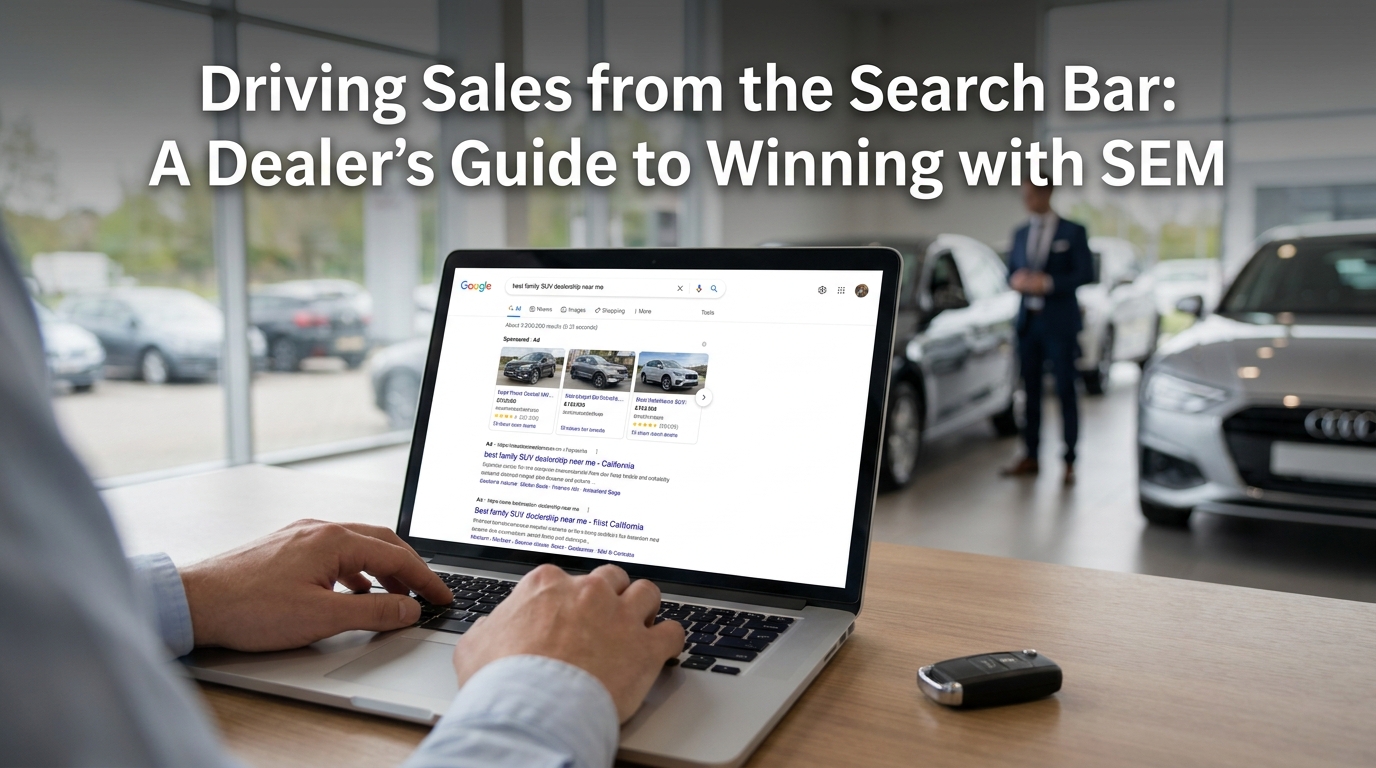
In today’s automotive landscape, the showroom floor has expanded far beyond your physical dealership. It now lives on the screens of smartphones, tablets, and laptops where the modern car buyer begins their journey. Before they ever smell that new car scent or kick a single tire, they are typing, searching, and comparing online. This is where the battle for the customer is won or lost. For car dealers aiming to thrive in this digital-first era, mastering Search Engine Marketing (SEM) is no longer an optional luxury; it’s a fundamental necessity. SEM, often used interchangeably with Pay-Per-Click (PPC) advertising, is the art and science of placing your dealership’s ads directly in front of motivated shoppers at the exact moment they are searching for a vehicle you sell or a service you provide. It’s a powerful tool that offers immediacy, precision, and a direct line to high-intent customers that slower, organic methods can’t always reach. This comprehensive guide will serve as your roadmap, navigating you through the essential tactics for automotive SEM. We’ll break down the basics, explore intelligent budget allocation, uncover winning keyword and ad strategies, and, most importantly, show you how to measure the metrics that truly impact your bottom line.
What is SEM and Why is it a Non-Negotiable for Car Dealers?
At its core, Search Engine Marketing is the practice of paying search engines like Google and Bing to display your ads in their search results. You’ve seen them a thousand times—they’re the listings at the very top of the page, often marked with a small “Ad” or “Sponsored” label. While its cousin, Search Engine Optimization (SEO), focuses on earning free, organic rankings over time, SEM provides instant visibility for a price. Think of it this way: SEO is like building a great reputation in town that slowly brings people to your door, while SEM is like placing a giant, flashing billboard on the busiest highway leading directly to your lot.
For a car dealership, the “why” behind SEM is incredibly compelling. It’s all about intent. Someone searching for “best family SUV” is in the research phase. But a person searching for “used honda pilot ex-l for sale near me” is a bottom-of-the-funnel, high-intent buyer who is likely ready to make a decision soon. SEM allows you to intercept that exact customer. Here’s why it’s so critical:
- Immediate Impact: SEO can take months to show significant results. A well-structured SEM campaign can start driving targeted traffic to your Vehicle Detail Pages (VDPs) and generating leads within hours of launch.
- Hyper-Targeting: SEM platforms offer a granular level of control that is unmatched. You can target potential customers based on their precise geographic location (down to a specific zip code), the device they’re using, the time of day they’re searching, and even their demographic profile. This ensures your ad dollars are spent reaching the most relevant audience.
- Competitive Edge: Take a moment and search for a popular model you sell in your area. Chances are, your top competitors are already there in the paid ad spots. If you’re not participating in SEM, you are effectively invisible for these crucial searches, handing potential sales directly to the dealership down the street.
- Measurable ROI: Unlike traditional advertising like radio spots or newspaper ads, every single aspect of an SEM campaign is trackable. You can see exactly how many people saw your ad, how many clicked it, and how many took a valuable action like calling your dealership or filling out a credit application. This data allows for precise calculation of your return on investment.
The Blueprint: Structuring Your Automotive SEM Strategy for Success
Jumping into SEM without a clear plan is like trying to sell a car without knowing its features. You might get lucky, but a strategic approach will yield far better and more consistent results. Building a winning SEM strategy starts with defining your objectives and structuring your campaigns logically.
Set Clear, Measurable Goals
First, ask yourself: what do we want to achieve with our SEM budget? Your goals will dictate every other decision you make. Avoid vague objectives like “get more website traffic.” Instead, focus on specific business outcomes:
- Generate High-Quality Leads: This is the most common goal. A lead can be defined as a form submission (test drive request, finance application, trade-in evaluation) or a phone call to your sales or service department.
- Increase VDP Views: Drive traffic directly to the pages of specific vehicles you want to move. This is a great goal for aging inventory or high-margin units.
- Boost Service Appointments: Don’t forget your service and parts department. A campaign focused on “oil change coupons” or “brake repair [Your City]” can be highly profitable.
- Drive Foot Traffic: Use location-based targeting and ad extensions to encourage shoppers to visit your physical dealership.
Choose Your Platforms and Structure Your Campaigns
While Google Ads is the undisputed leader, don’t overlook Microsoft Ads (formerly Bing Ads). It often has an older, more affluent user base and can deliver leads at a lower cost-per-click (CPC) due to less competition. A smart strategy often involves a presence on both platforms.
How you structure your account is paramount for budget control and relevance. A messy, disorganized account is inefficient and costly. A logical structure might look like this:
- Campaign: New Vehicles
- Ad Group: New Toyota Camry
- Ad Group: New Toyota RAV4
- Ad Group: New Toyota Tundra
- Campaign: Used Vehicles
- Ad Group: Used SUVs
- Ad Group: Used Trucks
- Ad Group: Used Cars Under $15k
- Campaign: Service & Parts
- Ad Group: Oil Change
- Ad Group: Tire Rotation
- Ad Group: Brake Service
- Campaign: Branded
- Ad Group: [Your Dealership Name]
This granular structure allows you to write highly specific ads for each ad group, direct users to the most relevant landing page, and allocate your budget to the campaigns that are performing best.
Fueling the Engine: Smart Budgeting and Bidding Tactics
One of the first questions every dealer asks is, “How much should I spend on SEM?” The honest answer is: it depends. Your budget will be influenced by your market size, the level of competition, your sales goals, and the average profit you make per vehicle. However, you can approach budgeting in a couple of strategic ways.
Budgeting Models for Dealerships
You can use a top-down approach, where you allocate a fixed monthly amount (e.g., $4,000) to SEM and work within that constraint. A more sophisticated method is the bottom-up, goal-based approach. For example: “Our goal is to generate 40 qualified sales leads this month. Historically, our SEM campaigns have a cost-per-lead of $50. Therefore, our required budget for this goal is 40 leads * $50/lead = $2,000.” This ties your ad spend directly to a tangible business outcome.
When allocating this budget across your campaigns, prioritize. You might put a larger percentage towards “Used Trucks” if that’s your most profitable segment, while dedicating a smaller portion to a branded campaign, which is designed to protect your dealership’s name from competitors and is typically very inexpensive.
Understanding Bidding Strategies
Your bid is what you’re willing to pay for a single click. Modern ad platforms offer a variety of automated bidding strategies that use machine learning to optimize for your goals. Here are a few key ones for dealers:
- Manual CPC: You set the maximum bid for each keyword. This gives you the most control but requires constant monitoring and adjustment. It’s a good way to start a campaign to gather initial data.
- Maximize Clicks: The platform’s AI will try to get you the most possible clicks within your daily budget. This is useful for campaigns aimed at driving a high volume of traffic to your site, such as getting more eyes on your overall inventory.
- Maximize Conversions: Once you have conversion tracking set up correctly (a must!), this strategy tells the algorithm to bid in a way that generates the most leads (form fills, calls) for your budget. This is the go-to strategy for most lead-generation-focused dealerships.
- Target CPA (Cost Per Acquisition): This takes it a step further. You tell the system exactly how much you are willing to pay for one lead (e.g., $45). The algorithm will then adjust your bids in real-time to try and hit that average cost.
The Art of the Keyword: Targeting In-Market Car Shoppers
Keywords are the foundation of your entire SEM effort. They are the bridge between what a potential customer is searching for and the ad you show them. Choosing the right keywords, and just as importantly, excluding the wrong ones, is critical to avoiding wasted ad spend.
Keyword Match Types
Search platforms give you control over how closely a user’s search query must match your keyword. Understanding these match types is crucial:
- Broad Match: The least restrictive. Your ad might show for searches that are vaguely related to your keyword. For dealers, this is often too broad and can result in clicks from irrelevant searches like “car mechanic jobs.” Use with extreme caution.
- Phrase Match (e.g., “used ford explorer”): Your ad will show for searches that include this phrase, potentially with words before or after it, like “best price on a used ford explorer” or “used ford explorer in Dallas.” This offers a good balance of reach and control.
- Exact Match (e.g., [used ford explorer]): The most restrictive. Your ad will only show for searches that are an exact match or a very close variant of that term. These keywords often have the highest conversion rates because the user’s intent is crystal clear.
Building Your Dealership’s Keyword List
Your list should be a mix of different keyword types. Brainstorm terms that your customers would use, including:
- Make & Model Keywords: “new chevy silverado,” “used honda cr-v for sale,” “2021 toyota camry deals.”
- Category Keywords: “used trucks near me,” “suv dealership [Your City],” “certified pre-owned cars.”
- Location-Based Keywords: “[Your City] ford dealer,” “jeep service center near me.”
- Financing & Deal Keywords: “bad credit car loans,” “toyota lease specials.”
- Branded Keywords: Bid on your own dealership’s name to ensure you appear first when someone searches for you directly.
The Power of Negative Keywords
Negative keywords are your campaign’s best defense against wasted clicks. These are terms that you explicitly tell the search engine *not* to show your ads for. Every dealership should have a master negative keyword list that includes terms like: “free,” “jobs,” “hiring,” “parts diagram,” “manual,” “recall,” “salvage,” “reviews,” and the names of cities or states you don’t serve.
Crafting Ads That Convert Clicks into Customers
A great keyword strategy gets your ad in front of the right person, but compelling ad copy is what earns the click. Your ad is your digital storefront sign—it needs to be eye-catching, informative, and persuasive.
The Anatomy of a High-Performing Ad
A standard text ad has a few key components you need to optimize:
- Headlines: You get multiple headlines, so use them wisely. Include your target keyword, your location, and a unique selling proposition (USP). For example: “Used F-150s in Springfield | Lifetime Powertrain Warranty | [Your Dealership Name]”.
- Descriptions: This is where you expand on your offer. Mention key benefits like “Easy Online Financing,” “Huge Selection In Stock,” or “Family-Owned Since 1985.” Always include a strong call-to-action (CTA).
- Call-to-Action (CTA): Don’t leave the user guessing. Tell them exactly what you want them to do next. Use action-oriented phrases like “View Our Inventory,” “Get Pre-Approved Now,” “Schedule a Test Drive,” or “Call for Today’s Price.”
Supercharge Your Ads with Extensions
Ad extensions are snippets of additional information that “extend” your ad, making it larger, more informative, and more likely to be clicked. They are free to add and can dramatically improve your click-through rate (CTR). Essential extensions for car dealers include:
- Sitelink Extensions: Add direct links to important pages on your site, like “New Inventory,” “Used Sedans,” “Service Center,” and “Financing.”
- Call Extensions: Puts your phone number directly in the ad, making it a single tap for mobile users to call you. This is a must-have.
- Location Extensions: Displays your dealership’s address, hours, and a link to Google Maps, making it easy for customers to find you.
- Image Extensions: Allows you to add relevant, visually appealing images alongside your text ads, helping you stand out on the results page.
- Promotion Extensions: Highlight specific sales and offers, like “15% Off Your Next Oil Change” or “0% APR Financing Event.”
Measuring What Matters: Dealership KPIs for SEM Success
The true power of digital marketing lies in its measurability. To ensure your SEM budget is working for you, you must move beyond vanity metrics like impressions and clicks and focus on Key Performance Indicators (KPIs) that directly correlate with your business goals.
Essential Metrics to Track and Understand
Log into your ads dashboard regularly and keep a close eye on these metrics:
- Click-Through Rate (CTR): Calculated as (Clicks ÷ Impressions) x 100. This percentage tells you how relevant your ads are to the people who see them. A low CTR could indicate weak ad copy or poorly targeted keywords.
- Cost Per Click (CPC): The average amount you pay each time someone clicks your ad. This is a primary cost metric you’ll want to manage and optimize.
- Conversion Rate: This is a massive indicator of success. Calculated as (Conversions ÷ Clicks) x 100, it shows the percentage of people who completed a desired action (a lead) after clicking your ad.
- Cost Per Conversion (or Cost Per Lead): Arguably the most important lead generation metric. It’s your total ad spend divided by the number of conversions. This tells you exactly how much it costs to generate one lead, allowing you to assess the campaign’s profitability.
- Impression Share: This metric reveals the percentage of time your ads were actually shown versus the total number of times they were eligible to be shown. A low impression share could mean your budget is too low or your bids are not competitive enough.
To accurately measure success, you absolutely need robust tracking in place. This includes conversion tracking within the ad platforms, Google Analytics on your website to see post-click behavior, and a dynamic call tracking solution. Call tracking is non-negotiable, as it allows you to attribute phone call leads directly back to the specific SEM campaign, ad group, and even keyword that generated them.
Conclusion: Driving Your Dealership Forward with Strategic SEM
Search Engine Marketing is a dynamic and powerful channel that puts your dealership directly in the path of your most motivated customers. It’s the modern equivalent of having the best location in town, ensuring that when someone is ready to buy, your name is the first one they see. However, success isn’t accidental. It’s the result of a deliberate, strategic, and data-driven approach. It begins with a firm understanding of the fundamentals and why SEM is so uniquely suited to the high-intent nature of the car buying process. From there, it requires building a solid foundation through clear goal-setting and a logical campaign structure that mirrors your business priorities. Fueling that structure with a smart budget and sophisticated bidding strategies ensures your resources are deployed efficiently. The core of your campaign—the keywords and ad copy—must be meticulously crafted to attract the right clicks and deter the wrong ones. Finally, and most critically, success is defined by a commitment to measurement. By moving beyond simple clicks and focusing on the metrics that matter, like cost per lead and conversion rate, you can transform your SEM from an expense into a highly profitable and predictable engine for growth. The digital landscape is always evolving, but by mastering these winning tactics, your dealership can not only compete but truly dominate your local market, ensuring a steady stream of traffic to both your website and your showroom floor.