Car Acronyms Decoded: Your Guide to ABS, VIN, and MPG
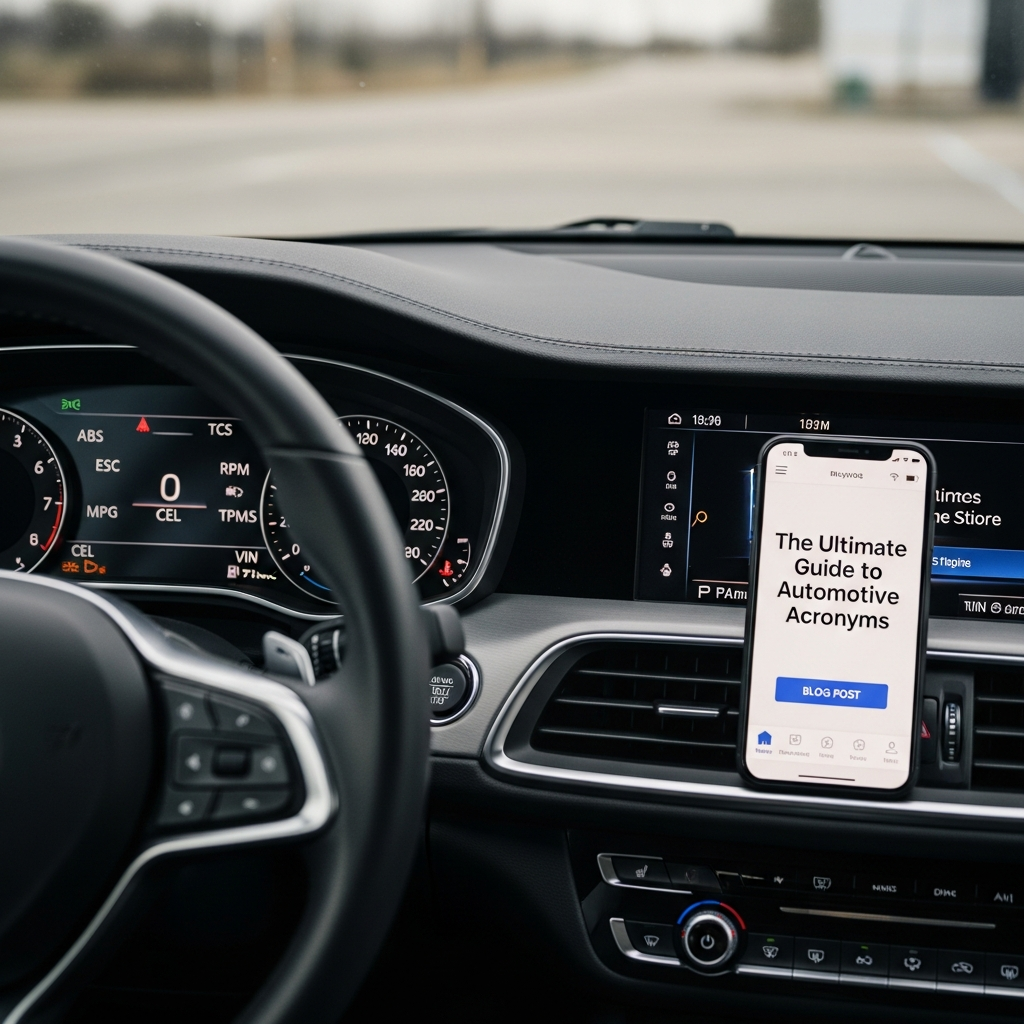
Have you ever found yourself at the mechanic’s shop, nodding along as they explain a problem with your car’s ABS module, all while secretly wondering if ABS is a type of plastic? Or perhaps you were at a dealership, and the salesperson started talking about the MSRP, the APR, and the OEM parts, making you feel like you needed a translator just to buy a car. The automotive world is filled with a seemingly endless “alphabet soup” of acronyms and initialisms. This technical jargon can be intimidating, making simple conversations about your vehicle feel like a high-level engineering exam. But what if you could crack the code? Understanding this language is more than just learning trivia; it’s about empowerment. Knowing what these terms mean can help you make smarter purchasing decisions, communicate more effectively with service technicians, and have a deeper appreciation for the complex machine you rely on every day. This guide is designed to be your friendly translator. We will break down the most common and important automotive acronyms, organizing them into logical categories so you can easily find what you’re looking for. We’ll move from the basics of identifying your car to the advanced safety systems that protect you, the performance metrics that excite you, and the diagnostic codes that warn you. By the end, you’ll be able to navigate the world of cars with newfound confidence.
The Foundation: Core Vehicle Identification and Documentation
Before we dive into the complex systems that make a car run, let’s start with its fundamental identity. Just like a person has a name and a birth certificate, every vehicle has unique identifiers and documents that tell its story. Understanding these is the first step to truly knowing your car.
VIN (Vehicle Identification Number)
The VIN is arguably the most important acronym associated with any vehicle. Think of it as your car’s unique fingerprint or its social security number. No two vehicles manufactured in the last 40 years share the same VIN. This 17-character code is a treasure trove of information. It’s not just a random string of letters and numbers; each position has a specific meaning, revealing the car’s country of origin, manufacturer, make and model, body style, engine size, model year, and even the specific plant where it was assembled. You can typically find the VIN on a small plate on the driver’s side of the dashboard (visible through the windshield), on the driver’s side door jamb sticker, and on your vehicle’s registration and insurance documents. It’s crucial for everything from registering your car and getting insurance to ordering the correct parts and, most importantly, checking a vehicle’s history for accidents or theft before you buy it.
MCO / MSO (Manufacturer’s Certificate of Origin / Manufacturer’s Statement of Origin)
When a car is brand new, it doesn’t have a title yet. Instead, it has an MCO or MSO. This is the vehicle’s legal birth certificate, issued by the manufacturer. It proves who made the vehicle and that it is brand new and has never been sold to a retail customer. When you buy a new car from a dealership, they will use the MCO to transfer ownership to you and register the vehicle with the state’s Department of Motor Vehicles (DMV). The DMV then issues the official title in your name, and the MCO is retired. You likely won’t ever handle the MCO yourself, but it’s a critical document in the process of bringing a new car from the factory floor to your driveway.
GVWR (Gross Vehicle Weight Rating)
This acronym is especially important for owners of trucks, vans, and large SUVs. The GVWR is the maximum total weight a vehicle is designed to carry, as determined by the manufacturer. This total weight includes the vehicle’s own curb weight (how much it weighs empty) plus the weight of all passengers, fuel, and cargo. You can find the GVWR on the same sticker in the driver’s side door jamb where you often find the VIN and recommended tire pressures. Exceeding the GVWR is dangerous. It puts immense strain on the vehicle’s frame, suspension, brakes, and tires, compromising its safety and handling. For anyone who tows a trailer or hauls heavy loads, understanding and respecting the GVWR is non-negotiable for safe operation.
Keeping You Safe: Essential Safety and Driver-Assistance Systems
Modern vehicles are marvels of safety engineering. Over the decades, a suite of sophisticated systems, all known by their acronyms, has become standard. These systems work silently in the background, ready to intervene in a split second to prevent an accident or reduce its severity. They are your invisible co-pilots on the road.
ABS (Anti-lock Braking System)
ABS is one of the most significant safety innovations in automotive history. Before ABS, slamming on the brakes in an emergency could cause the wheels to lock up, leading to an uncontrolled skid. ABS prevents this. It uses sensors at each wheel to detect when a wheel is about to lock during heavy braking. The system then rapidly “pumps” the brake on that wheel—much faster than a human could—to maintain traction while still allowing you to slow down as quickly as possible. This allows you to maintain steering control during an emergency stop, potentially letting you steer around an obstacle. If you ever feel a rapid pulsing or vibrating in the brake pedal during a hard stop, that’s the ABS doing its job.
ESC (Electronic Stability Control)
Often considered the most important safety feature since the seatbelt, ESC helps prevent skids and loss of control. While ABS works when you’re braking in a straight line, ESC works when you’re cornering or swerving. Using a variety of sensors that monitor steering angle and vehicle rotation, the system can detect when the car is about to understeer (plow straight ahead) or oversteer (the rear end swings out). When it detects a loss of traction, ESC can automatically apply the brakes to individual wheels and even reduce engine power to help bring the vehicle back under the driver’s intended path. It’s a lifesaver in slippery conditions or during sudden emergency maneuvers.
TCS (Traction Control System)
TCS is a subsystem of ESC, and they work hand-in-hand. While ESC prevents skids during cornering, TCS is focused on preventing your wheels from spinning during acceleration. If you press the gas pedal too hard on a wet, icy, or gravelly surface, the drive wheels can lose grip and just spin in place. TCS sensors detect this wheelspin and will intervene by reducing engine power or applying the brakes to the spinning wheel, allowing the tire to regain traction and propel the car forward safely.
ADAS (Advanced Driver-Assistance Systems)
ADAS is a broad category of modern safety features that use sensors like cameras, radar, and lidar to help the driver. This is where a lot of new acronyms live. Common examples include:
- ACC (Adaptive Cruise Control): An advanced form of cruise control that automatically adjusts your car’s speed to maintain a safe following distance from the vehicle ahead.
- BSM (Blind Spot Monitoring): Uses sensors to detect vehicles in your blind spots and alerts you with a light in your side mirror or an audible chime.
- LKA (Lane Keeping Assist): Uses a camera to monitor lane markings and can provide gentle steering input to help keep your vehicle centered in its lane.
Under the Hood: Deciphering Engine and Performance Lingo
For many, the heart of a car is its engine. The acronyms related to performance and what’s under the hood can tell you a lot about a vehicle’s character, efficiency, and power. Whether you’re a budding enthusiast or just curious, understanding these terms helps you understand what makes your car go.
RPM (Revolutions Per Minute)
This is a measure of how fast the engine’s crankshaft is spinning. You see it on your tachometer, the gauge next to your speedometer, usually numbered from 0 to 8 (representing 0 to 8,000 RPM). In general, higher RPMs mean the engine is working harder and producing more power, but it’s also consuming more fuel. Modern automatic transmissions are programmed to keep the engine at the most efficient RPM for a given speed to save fuel.
HP (Horsepower)
Horsepower is the classic measure of an engine’s power. In simple terms, it’s a measure of the rate at which the engine can do work. A higher horsepower rating generally means a car can achieve higher top speeds and accelerate more quickly. Think of it this way: torque (its close relative) gets the car moving, while horsepower keeps it moving at high speeds. It’s the number most often advertised and is a key indicator of a car’s performance potential.
MPG (Miles Per Gallon)
This is a crucial acronym for any car owner’s wallet. MPG measures a vehicle’s fuel efficiency—specifically, how many miles it can travel on one gallon of gasoline. You will almost always see two figures: one for city driving and one for highway driving. Highway driving is typically more efficient because you’re traveling at a steady speed without the constant starting and stopping of city traffic. A higher MPG number means better fuel economy and lower fuel costs over the life of the vehicle.
DOHC vs. SOHC (Dual Overhead Camshaft vs. Single Overhead Camshaft)
This gets a bit more technical, but it’s a common term in engine specifications. A camshaft is a rotating shaft with lobes that open and close the engine’s intake and exhaust valves. In a SOHC engine, one camshaft per cylinder head operates all the valves. In a DOHC engine, there are two camshafts per head—one dedicated to the intake valves and another for the exhaust valves. Generally, DOHC designs allow for better engine breathing, which can lead to higher performance and better efficiency, which is why they are common in most modern cars.
When Things Go Wrong: Diagnostics and Maintenance Acronyms
Sooner or later, a warning light will illuminate on your dashboard. These lights are your car’s way of telling you something needs attention. Understanding the acronyms associated with vehicle diagnostics can take the mystery and fear out of that little glowing icon.
CEL (Check Engine Light)
The CEL is perhaps the most dreaded and misunderstood warning light. It’s an amber-colored light, often shaped like an engine outline. When it lights up, it means the vehicle’s onboard computer has detected a problem in the engine or emissions control system. The issue could be something as simple as a loose gas cap or something more serious like a failing catalytic converter. A steady CEL means you should get the car checked soon. A flashing CEL indicates a severe problem, like a misfire that could damage expensive components, and you should pull over and shut off the engine as soon as it’s safe to do so.
OBD-II (On-Board Diagnostics II)
So, how do you find out why the CEL is on? The answer is the OBD-II port. Since 1996, every car sold in the U.S. has been required to have this standardized port, usually located under the dashboard on the driver’s side. A mechanic (or you, with a simple scanner tool) can plug into this port to communicate with the car’s computer. The computer will provide a specific code that points to the source of the problem, taking the guesswork out of the diagnosis.
DTC (Diagnostic Trouble Code)
When you scan the OBD-II port, the information you get is a DTC. This is an alphanumeric code that corresponds to a specific fault. For example, a code like “P0301” indicates a misfire in cylinder number 1. While the code doesn’t tell you exactly *why* the cylinder is misfiring (it could be a bad spark plug, a faulty fuel injector, or a wiring issue), it narrows the problem down dramatically, allowing for a much faster and more accurate repair.
TPMS (Tire Pressure Monitoring System)
This is another common warning light, usually looking like a cross-section of a tire with an exclamation point inside. The TPMS is a safety system that monitors the air pressure in your tires. If the pressure in one or more tires drops significantly below the recommended level, the light will turn on. This is a crucial warning, as underinflated tires can lead to poor handling, increased braking distances, excessive tire wear, and even a dangerous blowout. It’s a simple reminder to check your tire pressure and add air when needed.
Navigating the Dealership: Sales and Financing Terms
Buying a car involves its own unique language. The acronyms you encounter during the sales and financing process can have a major impact on how much you pay. Knowing what they mean can help you become a more confident and savvy negotiator.
MSRP (Manufacturer’s Suggested Retail Price)
Also known as the “sticker price,” the MSRP is the price the carmaker recommends that the dealership sells the vehicle for. It’s important to remember the word “suggested.” The MSRP is a starting point for negotiations, not a final price. It includes the base price for the model and trim, plus the cost of any optional features installed at the factory. It does not include taxes, registration fees, or dealer-added accessories.
APR (Annual Percentage Rate)
If you’re financing your vehicle with a loan, the APR is one of the most important numbers to understand. It represents the total annual cost of borrowing money, expressed as a percentage. The APR includes the interest rate plus any additional lender fees. A lower APR means you’ll pay less in interest over the life of the loan. Even a small difference in the APR can add up to hundreds or thousands of dollars, so it’s always wise to shop around for the best financing rate before you go to the dealership.
OEM (Original Equipment Manufacturer)
OEM refers to parts that are made by the vehicle’s original manufacturer or the company that supplied the parts to the manufacturer for assembly. When you take your car to a dealership for repairs, they will almost always use OEM parts. These parts are designed to be a perfect fit and function for your specific vehicle. The alternative is “aftermarket” parts, which are made by third-party companies. While sometimes less expensive, their quality and fit can vary. For critical components, using OEM parts is often the safest bet.
The Electric Future: EV, HEV, and PHEV Explained
As the automotive industry shifts towards electrification, a whole new set of acronyms has entered our vocabulary. Understanding the differences between these terms is key to navigating the modern car market and choosing the right type of eco-friendly vehicle for your needs.
EV (Electric Vehicle)
EV is the broad, catch-all term for any vehicle that uses one or more electric motors for propulsion. However, when people say “EV,” they are most often referring to a specific type of electric vehicle, which brings us to our next term.
BEV (Battery Electric Vehicle)
A BEV is what most people picture when they think of an EV. It runs entirely on electricity stored in a large battery pack. It has no gasoline engine, no fuel tank, and no exhaust pipe. You “refuel” a BEV by plugging it into an electrical outlet or a dedicated charging station. They produce zero tailpipe emissions and offer a quiet, smooth, and often very quick driving experience.
HEV (Hybrid Electric Vehicle)
An HEV is a traditional hybrid, like the original Toyota Prius. It has both a gasoline engine and an electric motor. The electric motor assists the gas engine to improve fuel efficiency. The battery in an HEV is small and is recharged through a process called regenerative braking (capturing energy when you slow down) and by the gasoline engine itself. You cannot plug in a traditional HEV to charge it. It always relies on gasoline as its primary fuel source, but it uses significantly less of it than a non-hybrid car.
PHEV (Plug-in Hybrid Electric Vehicle)
A PHEV is a bridge between a hybrid and a full-electric car. Like an HEV, it has both a gas engine and an electric motor. However, it has a much larger battery pack that can be charged by plugging it into an outlet, just like a BEV. This allows a PHEV to travel a certain distance (typically 20-50 miles) on pure electric power alone. For daily commutes, many PHEV owners may never need to use the gas engine. But for longer trips, the gasoline engine is there as a backup, eliminating the “range anxiety” sometimes associated with BEVs.
kWh (Kilowatt-hour)
Just as MPG measures a gas car’s efficiency, kWh is a key metric for electric vehicles. A kilowatt-hour is a unit of energy, and it’s used to measure the capacity of a BEV’s or PHEV’s battery pack. You can think of it as the size of the “electric tank.” A car with a 75 kWh battery can store more energy and generally has a longer electric range than a car with a 50 kWh battery. You’ll also see efficiency measured in terms of kWh per 100 miles, where a lower number is better, indicating the car uses less energy to travel.
Conclusion: From Confusion to Confidence
The world of automotive acronyms can certainly feel like a language all its own. From the fundamental VIN that gives a car its identity, to the complex ADAS features that keep us safe, and the emerging terminology of the EV revolution, this “alphabet soup” is woven into every aspect of owning and operating a vehicle. At first glance, the sheer number of terms may seem overwhelming, but as we’ve seen, breaking them down by category makes them much more manageable. Understanding these acronyms is a powerful tool. It transforms you from a passive passenger into an informed and confident driver, buyer, and owner. You can now walk into a service center and understand what it means when they discuss your car’s TPMS or ESC system. You can browse new car listings and know the real-world difference between an HEV and a PHEV. You can negotiate a car purchase with a clear understanding of the MSRP and APR. You are better equipped to read your owner’s manual, diagnose minor issues, and make smarter decisions about maintenance and repairs. The goal isn’t to become a master mechanic overnight, but to build a foundation of knowledge that demystifies the machine you depend on. The next time you’re faced with a new car acronym, you’ll have the confidence to look it up, understand its context, and continue building on your automotive education. You’ve learned the ABCs, and now you’re ready to read the whole book.