Auto Dealer Website Trends, SEO, and Tools for Sales
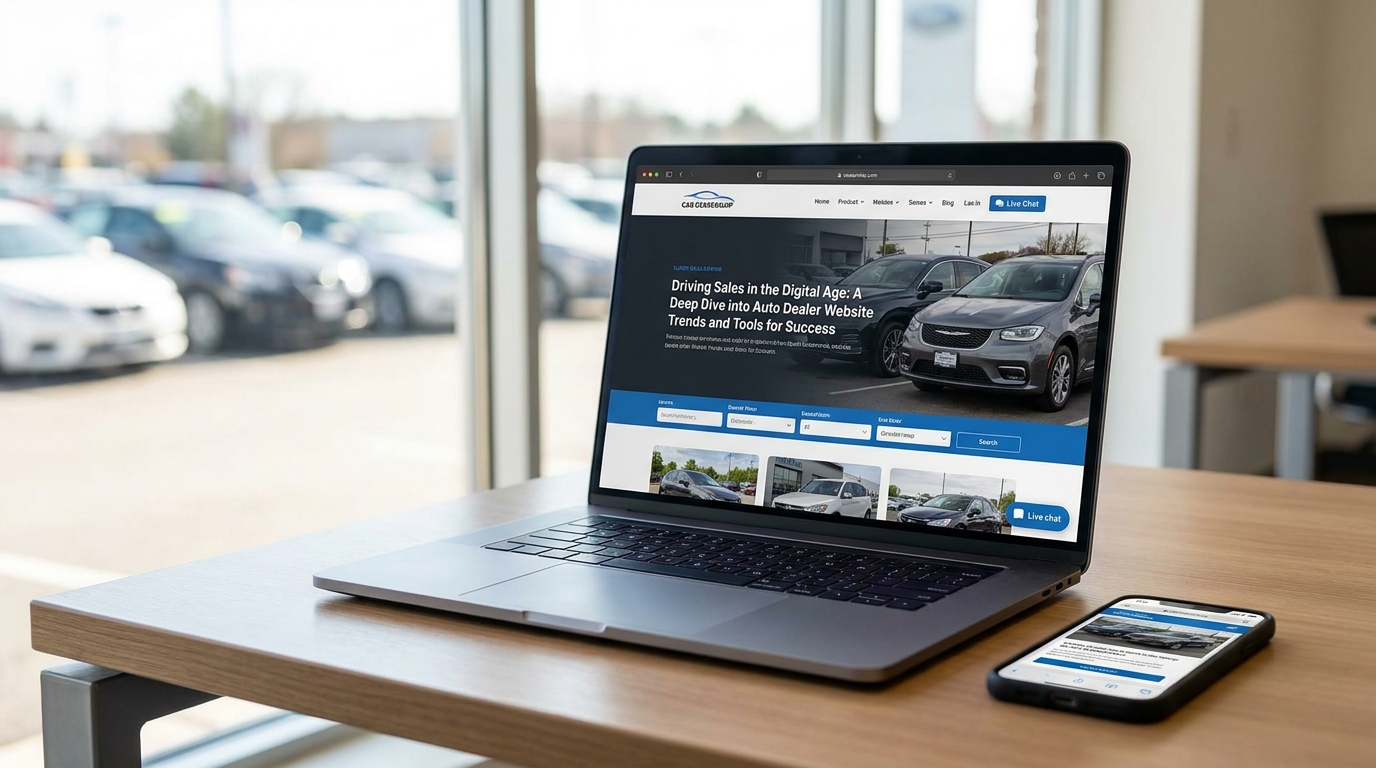
In the fast-paced world of automotive sales, the digital showroom has become just as crucial, if not more so, than the physical one. Today’s car buyer is more informed, more connected, and more likely to begin their journey online than ever before. Gone are the days when a dealership website was merely a digital business card with a physical address and a phone number. The modern auto dealer website is a dynamic, multifaceted sales and marketing engine, the central hub of a dealership’s digital strategy. It’s where first impressions are made, where trust is built, and where the sales process officially begins. A potential customer is likely to visit your website long before they ever step foot on your lot. This initial online interaction can determine whether they choose your dealership or your competitor down the street. This article will serve as a comprehensive guide to building a successful auto dealer website. We will explore the foundational pillars of modern web design, including the non-negotiable need for responsive design, the critical role of automated inventory feeds in showcasing your product, and the powerful strategies of automotive SEO needed to attract qualified, local buyers. We’ll also delve into emerging trends like digital retailing and the essential tools that transform a static website into an interactive and profitable platform.
The Digital Showroom: Why Your Website is Your Most Important Salesperson
The paradigm of car shopping has fundamentally shifted. Research from Google indicates that the vast majority of car buyers use online resources during their purchasing journey. They compare models, read reviews, watch videos, and, most importantly, browse local dealership inventory. Your website is their first point of contact with your brand, your inventory, and your team. It operates 24/7, serving as a tireless salesperson that answers questions, showcases vehicles, and captures leads even when your physical doors are closed. A poorly designed, slow, or outdated website creates immediate friction. It signals to a potential buyer that your dealership may be out of touch or difficult to work with. Conversely, a clean, fast, and user-friendly website instills confidence and makes a powerful first impression.
Think of your website as the digital extension of your physical showroom. Is it welcoming? Is it easy to navigate? Can customers find what they’re looking for quickly? The goal is to replicate the positive aspects of an in-person visit within a digital environment. This means providing detailed information, high-quality visuals, and transparent pricing. Every element, from the homepage banner to the call-to-action on a vehicle detail page, should be strategically designed to guide the user along the path to purchase, whether that’s scheduling a test drive, applying for financing, or simply getting directions to your dealership. In this competitive landscape, an underperforming website isn’t just a missed opportunity; it’s a direct funnel of customers to your competitors.
Responsive Design: The Cornerstone of a Modern User Experience
In an era dominated by smartphones, responsive design is not a feature; it’s a fundamental requirement. Responsive design ensures that your website automatically adjusts its layout, images, and content to fit the screen size of any device, whether it’s a desktop computer, a tablet, or a smartphone. Considering that a significant portion of automotive website traffic comes from mobile devices, a site that isn’t mobile-friendly is actively turning away a huge segment of potential customers. Users will not tolerate pinching and zooming to read text or struggling to click on tiny buttons. They will simply leave and go to a competitor’s site that offers a better experience.
Beyond user experience, responsive design is a critical factor for search engine optimization (SEO). Google has long since moved to a “mobile-first” indexing model. This means that Google predominantly uses the mobile version of your website’s content for indexing and ranking. If your site performs poorly on mobile, your search engine rankings will suffer, making it harder for local buyers to find you. Key elements of a strong responsive design for an auto dealer website include:
- Fast Loading Times: Mobile users are impatient. Pages should load in three seconds or less. This requires optimizing images, using efficient code, and choosing a reliable hosting provider.
- Thumb-Friendly Navigation: Menus, buttons, and links should be large enough and spaced appropriately so they can be easily tapped with a thumb.
- Simplified Forms: Lead forms for test drives or credit applications should be short and easy to complete on a small screen.
- Click-to-Call Functionality: Your dealership’s phone number should be a clickable link, allowing mobile users to call you with a single tap.
Investing in a fully responsive website is investing in accessibility and visibility. It ensures that every visitor, regardless of their device, has a seamless and productive experience with your digital showroom.
Inventory Feeds and VDPs: Your Most Valuable Digital Assets
While design creates the first impression, your inventory is the core of your business and your website. The way you present your vehicles online directly impacts lead generation and sales. This is where automated inventory feeds and well-crafted Vehicle Detail Pages (VDPs) become indispensable.
The Power of an Automated Inventory Feed
An inventory feed is a data file that automatically syncs the vehicles on your lot with the vehicles displayed on your website and third-party listing sites like Autotrader or Cars.com. This automation is crucial for several reasons:
- Accuracy: It eliminates the dreaded “I’m sorry, that car just sold” conversation. When a car is sold, it’s automatically removed from the website, and when a new car arrives, it’s automatically added. This builds trust and prevents customer frustration.
- Efficiency: Manually updating hundreds of vehicle listings is an impossibly time-consuming and error-prone task. An automated feed, typically from a tool like vAuto, HomeNet, or your Dealer Management System (DMS), frees up your staff to focus on selling cars rather than managing data entry.
- Consistency: The feed ensures that information about a vehicle—its price, mileage, VIN, and features—is consistent across all the platforms where you advertise.
Crafting High-Converting Vehicle Detail Pages (VDPs)
The VDP is where the customer makes a critical decision. It’s the digital equivalent of walking around the car on the lot, kicking the tires, and looking under the hood. A compelling VDP can be the difference between a bounce and a lead. Essential components of a high-converting VDP include:
- High-Quality Media: This is non-negotiable. Provide a gallery of at least 20-30 high-resolution photos of each vehicle, showing the exterior from all angles, the interior, the engine, and any special features or imperfections on used cars. 360-degree interior and exterior views, along with a short walk-around video, can significantly increase engagement.
- Transparent Pricing: Display pricing clearly. Show the MSRP, any dealer discounts, and an “ePrice” or “Internet Price” to encourage online inquiries. Hiding the price behind a “Call for Price” button creates a barrier and frustrates users.
- Detailed Specifications and Comments: Automatically pull in all the standard features, but also include custom dealer comments. This is your chance to sell the car. Highlight unique selling points, recent service history, or special packages.
- Clear Calls-to-Action (CTAs): Don’t make the user guess what to do next. Provide prominent, clear buttons like “Schedule Test Drive,” “Check Availability,” “Get ePrice,” or “Value Your Trade.”
- Trust-Building Elements: Include a CARFAX report for used vehicles, warranty information, and customer reviews to build confidence.
- Interactive Tools: A payment calculator allows users to estimate their monthly payments, making the purchase feel more tangible and helping them qualify themselves.
Automotive SEO: Driving Qualified Traffic to Your Digital Lot
Having a beautiful, functional website with a perfectly managed inventory is pointless if no one can find it. Automotive Search Engine Optimization (SEO) is the process of optimizing your website to rank higher in search engine results for queries relevant to your business. For a car dealer, this means appearing when a local customer searches for “used Honda CR-V near me” or “Ford dealership in [Your City].”
On-Page and Technical SEO for Dealerships
On-page SEO involves optimizing the content on your website itself. Every VDP should have a unique title tag and meta description that includes the year, make, model, trim, and your location (e.g., “Used 2021 Toyota RAV4 XLE for Sale in Springfield, IL”). Your Search Results Pages (SRPs), also known as inventory listing pages, should also be optimized for broader terms like “Used SUVs for Sale in Springfield.” Technical SEO ensures your site is structured in a way that search engines can easily crawl and understand. This includes having a clean URL structure, a fast site speed, and a sitemap that lists all your inventory pages.
Local SEO: Winning the “Near Me” Search
Since most car buyers purchase from a local dealership, local SEO is paramount. The cornerstone of local SEO is your Google Business Profile (GBP). It is absolutely essential that your GBP listing is fully optimized and accurate. This includes:
- Consistent NAP: Your dealership’s Name, Address, and Phone number (NAP) must be identical across your website, your GBP, and all other online directories.
- Photos and Videos: Regularly upload high-quality photos of your showroom, service bays, staff, and new inventory to your GBP.
- Customer Reviews: Actively encourage satisfied customers to leave reviews on Google. Respond to all reviews, both positive and negative, to show that you are engaged and value customer feedback.
- GBP Posts: Use Google Posts to promote special offers, new arrivals, or community events.
Creating location-specific pages on your website for the different towns and neighborhoods you serve can also significantly boost your local search visibility.
Integrating Digital Retailing: Bridging the Gap from Clicks to Customers
The latest evolution in auto dealer websites is the integration of digital retailing tools. These tools allow customers to move further down the sales funnel online, from the comfort of their own homes. This trend accelerated dramatically in recent years and has become a consumer expectation. It’s about offering convenience and transparency, which ultimately builds trust and creates a more streamlined process for both the customer and the dealership.
What does digital retailing encompass? It’s not necessarily about a completely online, touchless car-buying experience (though that can be an option). More commonly, it’s a suite of tools that allow the customer to:
- Structure Their Deal: Use advanced payment calculators that factor in down payment, credit score, and loan term to see a realistic monthly payment.
- Get a Firm Trade-in Offer: Integrate tools that provide a real, committable offer for their trade-in vehicle, not just a vague estimate.
- Apply for Financing: Complete a full credit application online and receive pre-approval from your dealership’s lending partners.
- Select F&I Products: Browse and add service contracts, GAP insurance, or other protection products to their deal.
- Schedule Delivery: Finalize the details and schedule a time to either pick up the vehicle or have it delivered.
The benefits are twofold. For the customer, it saves hours at the dealership and provides a pressure-free environment to make financial decisions. For the dealer, it delivers a more qualified, committed lead who has already done most of the legwork. When that customer walks into the showroom, the conversation shifts from negotiation to confirmation, leading to a faster, more efficient, and more pleasant sales process for everyone involved.
Essential Tools and Technologies for a High-Performing Website
Beyond the core pillars of design, inventory, and SEO, a suite of modern tools can elevate your website from a simple brochure to a lead-generating powerhouse. Integrating the right technologies enhances user engagement and provides you with invaluable data to refine your strategy.
- Chatbots and Live Chat: Instant gratification is key. A live chat or an AI-powered chatbot provides immediate answers to customer questions, 24/7. It can help a user find a specific vehicle, check business hours, or schedule a service appointment, all while capturing their contact information as a lead for your sales team.
- Analytics and Tracking: You can’t improve what you don’t measure. Tools like Google Analytics are essential for understanding how users find and interact with your site. You can track which vehicles get the most VDP views, which marketing channels drive the most traffic, and where users are dropping off in the process. More advanced tools like heatmaps can visually show you where users are clicking, helping you optimize your page layouts and CTAs.
- CRM Integration: Speed to lead is critical in auto sales. Your website must be seamlessly integrated with your Customer Relationship Management (CRM) system. When a customer fills out a form or interacts with a chatbot, that lead should be instantly and automatically routed to the appropriate salesperson in your CRM for immediate follow-up. Manual lead entry is a recipe for lost opportunities.
- Personalization Technology: Modern website platforms can use cookies and browsing history to personalize the user experience. If a visitor has repeatedly looked at Ford F-150s, your website can greet them on their return visit with a banner showcasing your current F-150 inventory or special offers on that model. This level of personalization makes the customer feel understood and increases the relevance of your website content.
Conclusion: Your Digital Future Starts with a Better Website
In conclusion, the role of the auto dealer website has transformed from a static online placeholder to the dynamic, beating heart of a dealership’s entire marketing and sales operation. It is the digital front door, the primary showroom, and often, the first and most critical interaction a customer will have with your business. Success in this digital-first landscape hinges on a holistic approach. It begins with a foundation of flawless, mobile-first responsive design that guarantees a seamless experience for every visitor, no matter their device. It is built upon a real-time, accurate, and automated inventory feed that populates richly detailed Vehicle Detail Pages, complete with high-quality photos, videos, and transparent pricing. To ensure customers can find this digital showroom, a robust and localized automotive SEO strategy is not optional; it is essential for capturing the high-intent “near me” searches that drive foot traffic. Finally, embracing modern trends like integrated digital retailing tools and leveraging technologies such as live chat, CRM integration, and analytics allows you to meet modern consumer expectations for convenience and transparency. By investing in these key areas, you are not just building a website; you are building a powerful engine for lead generation, customer satisfaction, and long-term, sustainable growth in an increasingly competitive automotive market.